Five Hundred Years of Printing by S. H. Steinberg
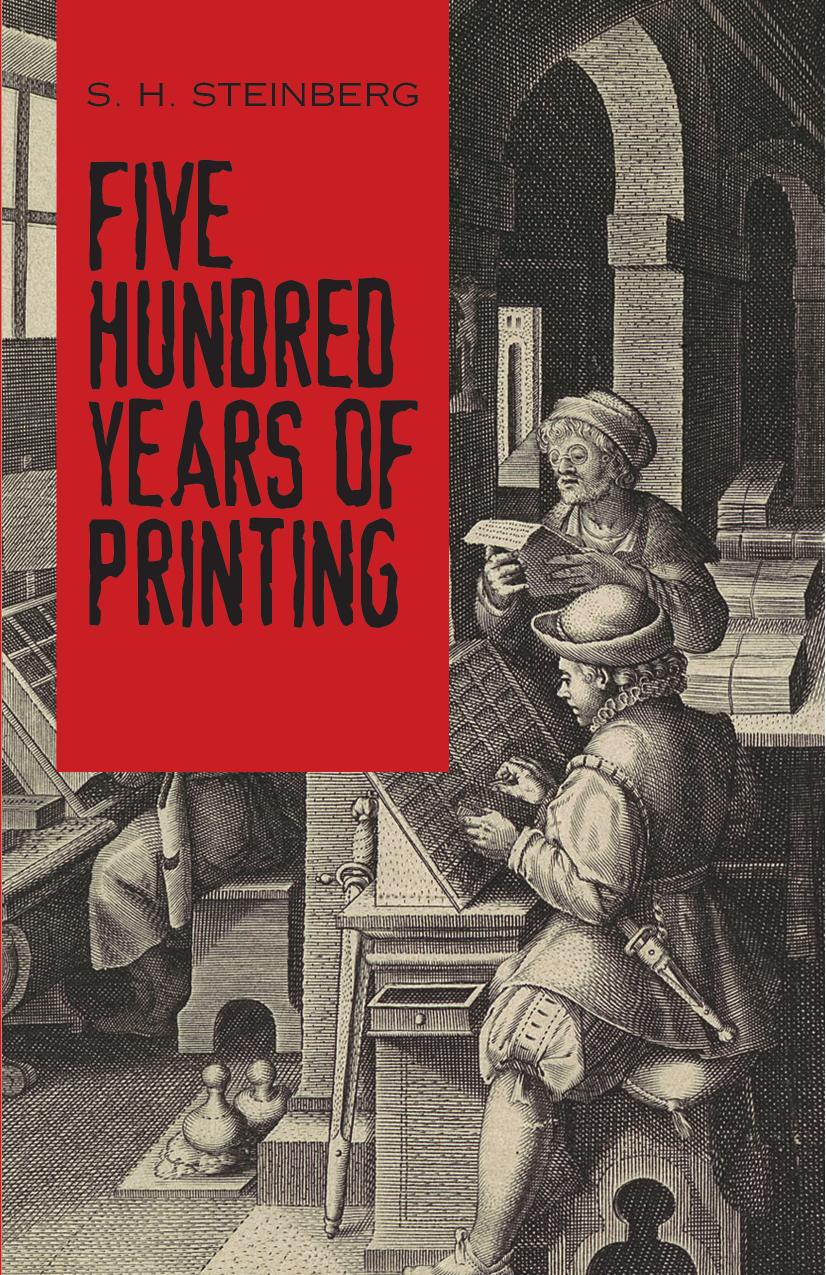
Author:S. H. Steinberg [S.H. Steinberg]
Language: eng
Format: epub, pdf
Publisher: Dover Publications
Published: 2017-05-30T04:00:00+00:00
3. PUBLISHERS AND PATRONS
THE gradual divergence of printer, publisher, and bookseller can be traced through the various forms which the imprint has taken. All three agents still appear until the end of the seventeenth century in a combination such as: ‘ Printed by Tho. Cotes, for Andrew Crook, and are to be sold at the black Bare in Pauls Church-yard’ (Thomas Hobbes’s Briefe of the Art of Rhetorique, 1637). It can usually be assumed that the bookshop to which buyers were thus directed was controlled by the publisher. This is confirmed by the imprint of another book by Hobbes, which runs: ‘ Printed for Andrew Crooke, and are to be sold at his shop, at the Sign of the Green-Dragon in St. Paul’s Church-yard, 1662’. It is a sign of the growing importance of the publisher over the printer that the latter’s name most easily disappeared from the imprint. Thus the first edition of Cervantes’ Don Quixote (1605) only refers to the publisher and the bookseller: ‘ En Madrid, por Iuan de la Cuesta. Véndese en casa de Francisco de Robles, librero del Rey’. On the other hand, the first Shakespeare folio mentions the printers only: ‘ Printed by Isaac laggard, and Ed. Blount, 1623’. Rarest is the omission of the publisher’s name in favour of those of the printer and bookseller, as in ‘ Printed and Sold by B. Franklin’, when it is to be inferred that the actual risk of the production – the publisher’s main function – was also borne by the same man. On the other hand, W. S. Landor paid himself for the production of his Poems from the Arabic and Persian, which came out in 1800 as ‘ Printed by H. Sharpe, High Street, Warwick, and sold by Messrs Rivingtons, St. Paul’s Church Yard’. But the phrase ‘ Printed for William Crook at the Green Dragon without Temple-Bar’ is the version which remained most commonly in use until book-publisher and bookseller, too, parted company. The improved organization of the retail trade made it unnecessary for the publisher to rely on the good-will of any special retailer. A Leipzig publisher, in 1717, seems to have taken the lead in boldly advertising that his publications are ‘ available in every bookshop’. Since that time, the fact or fiction that every bookseller of repute has, or at least ought to have, his books in stock has become part and parcel of the modern publisher’s publicity.
The occasions when printer and publisher are identical have become increasingly rare. In these cases, whether it is a historic relic or a conscious pride in the art of typography, the imprint almost invariably stresses the fact that the book is published by its printer rather than that the printing has been done by its publisher. ‘ Typis Johannis Baskerville’, ‘ Impresso co’ caratteri bodoniani’, ‘ De l’Imprimerie royale’, ‘ Druck und Verlag von B. G. Teubner’ are typical examples.
Similarly, the publishing firms maintained by the universities are generally known by the name of the printing establishments.
Download
Five Hundred Years of Printing by S. H. Steinberg.pdf
This site does not store any files on its server. We only index and link to content provided by other sites. Please contact the content providers to delete copyright contents if any and email us, we'll remove relevant links or contents immediately.
Still Foolin’ ’Em by Billy Crystal(36462)
Spell It Out by David Crystal(36231)
The Great Music City by Andrea Baker(33550)
Professional Troublemaker by Luvvie Ajayi Jones(29753)
Trainspotting by Irvine Welsh(21965)
Call Me by Your Name by André Aciman(20711)
The Secret History by Donna Tartt(19460)
We're Going to Need More Wine by Gabrielle Union(19167)
Cat's cradle by Kurt Vonnegut(15549)
Ready Player One by Cline Ernest(15139)
Molly's Game by Molly Bloom(14254)
Bombshells: Glamour Girls of a Lifetime by Sullivan Steve(14215)
The Goal (Off-Campus #4) by Elle Kennedy(13960)
Leonardo da Vinci by Walter Isaacson(13505)
4 3 2 1: A Novel by Paul Auster(12609)
The Social Justice Warrior Handbook by Lisa De Pasquale(12290)
The Break by Marian Keyes(9486)
Crazy Rich Asians by Kevin Kwan(9413)
The remains of the day by Kazuo Ishiguro(9211)
